The Seasonal Stuff Trap: When a £1.50 Bargain Becomes Clutter
You pop in for milk and bread and somehow leave with a pink ghost wearing a sparkly cowboy hat. Sound familiar? Here's why seasonal bargains are one of the sneakiest sources of clutter — and what to do about it.
The Seasonal Stuff Trap: When a £1.50 Bargain Becomes Clutter
Do you get sucked into buying the seasonal stuff in the supermarket?
You know what it's like.
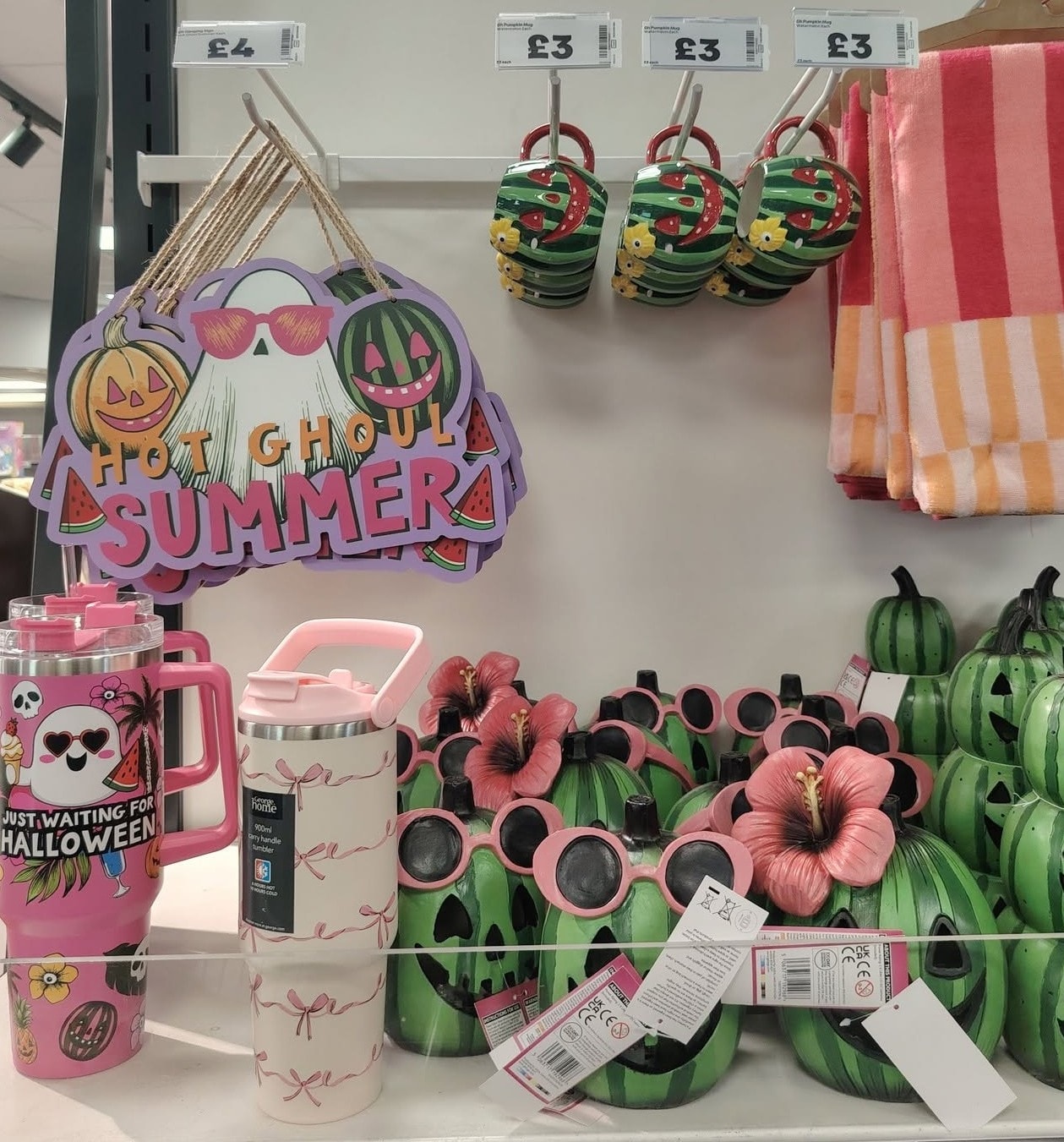
You pop into the supermarket for milk and bread and somehow, 20 minutes later, you're standing at the checkout with a pink ghost wearing a sparkly cowboy hat.
You look at it.
"Ooh, that's cute."
And then:
"It's only £1.50!"
Into the basket it goes.
And let's be honest, we've all done it.
But why?
Is it because we genuinely want it?
Because it makes us smile?
Because everyone else seems to have one?
Or because we're being absolutely bombarded with images of beautifully decorated homes on social media, where apparently every season, holiday and minor calendar event requires a complete change of décor?
Halloween.
Easter.
Valentine's Day.
Christmas.
Autumn.
Summer.
And apparently National Pumpkin Spice Day is probably coming next.
Before you know it, your home is full of stuff for occasions that last a few weeks – or sometimes just a few days.
And then what?
Where does all this stuff actually go?
Usually, one of three places.
1. It gets perfectly stored until next year
You've got a labelled box.
Everything is neatly packed away.
You know exactly where it is.
Excellent.
Except… when next Halloween comes around, perhaps you've moved on.
Maybe you're no longer in your Taylor Swift cowboy-hat era.
Maybe the trend has changed.
Maybe your children have grown up.
Maybe you simply don't like it anymore.
So the box gets opened, a few things come out, and the rest go straight back in.
2. It gets shoved somewhere and forgotten about
The loft.
The garage.
The back of a cupboard.
Under the bed.
In a box inside another box.
You vaguely remember owning it, but you couldn't tell anyone exactly where it is.
And because you can't find it when you need it, you buy more.
Which is how you end up with three sets of Halloween decorations, two boxes of Easter bits and absolutely no idea where the bloody pumpkin lights are.
3. It eventually gets decluttered
And then, five years later, you're standing in front of a box thinking:
"Why on earth have I kept this?"
You haven't seen it.
You haven't used it.
You don't even particularly like it.
And now it has become someone else's problem – or, potentially, landfill.
I recently came across a post from someone who said that every time they see the latest seasonal decorations, they think of them as "landfill toys".
And once you've heard that, it's quite difficult to unsee it.
Not every seasonal decoration is destined for landfill, of course. Some things are genuinely loved, reused year after year and become part of family traditions.
Think classic Christmas decorations that have been around for decades and get passed down through generations.
That's different.
A £1.50 plastic decoration bought because it was cheap, trendy and sitting beside the milk is a different proposition.
But there's something else going on here
Because this isn't just about stuff.
It's about buying habits.
We're constantly being encouraged to buy more.
New season.
New trend.
New colour.
New aesthetic.
New must-have.
And social media doesn't exactly help.
We see other people's homes looking beautiful and finished and decorated for every occasion, and without even realising it we can start comparing our own homes.
Should I be doing that?
Wouldn't my house look better if…?
Everyone else has one.
It's only £1.50.
Research into materialism has found that a strong focus on acquiring possessions is generally associated with poorer wellbeing, while research specifically looking at clutter has found links between clutter and reduced psychological wellbeing.
And a more recent study found that greater home clutter was associated with more negative affect, lower life satisfaction and poorer mental wellbeing.
So perhaps the question isn't:
"Where can I store all this?"
Perhaps it's:
"Do I actually want this in my home in the first place?"
Stop clutter at the front door
This is one of the biggest advantages of stopping clutter before it comes into your home.
Once you've bought something, it becomes your problem.
You have to store it.
Organise it.
Remember where it is.
Find it.
Clean around it.
Move it.
Decide whether to keep it.
And eventually, perhaps, get rid of it.
That's a lot of life admin for something that cost £1.50.
So before you put that seasonal bargain in your basket, try asking yourself:
Would I buy this if it wasn't on offer?
Do I actually love it?
Where will I keep it?
Will I still want it next year?
Am I buying it because I want it – or because I'm being sold the idea that I need it?
And perhaps the most important one:
If I didn't buy this today, would I even think about it tomorrow?
Because sometimes the best bargain is the thing you don't buy.
And what about the stuff you already have?
We're not suggesting you suddenly empty your house into a skip.
Far from it.
If seasonal decorating is something you genuinely enjoy, keep the things you love and use them.
The aim isn't to remove all the fun.
It's to make the stuff you own work for your life.
If you go all-out at Halloween, brilliant.
Have your Halloween decorations.
But make sure you know where they are.
Keep them together.
Use a clear, labelled storage box if that works for you.
And, personally, we'd suggest giving yourself a limit.
One box per season.
Halloween.
Easter.
And let's not even talk about Christmas yet…
If it doesn't fit, perhaps it's time to have a rethink.
And then there's the really difficult stuff…
Because sometimes the reason we keep things has absolutely nothing to do with the thing itself.
I used to hold a Halloween party for children every year.
And not just a little bit of Halloween.
The house was decorated to within an inch of its life.
I'm a sucker for a bargain, so after Halloween I'd buy up the leftovers cheaply and put them away ready for the following year's party.
I had a plan.
I had a reason.
I had an event to use it all for.
Except…
Those children are now 17.
The parties stopped.
And I missed them.
I really missed them.
So getting rid of those decorations wasn't simply a case of deciding whether I liked a plastic skeleton.
It was about letting go of something that represented a time in my life that I loved.
And that can be much, much harder.
Because sometimes we're not keeping the stuff.
We're keeping the memory, the person, the tradition or the version of ourselves that came with it.
It has taken me years to get to the point where I've finally whittled my Halloween decorations down to what I actually use – the bits that go on the front door and window.
The rest?
I've passed them on to someone who will actually use them and enjoy them.
And honestly, that feels much better than having them sitting in a box in my house simply because I couldn't quite bring myself to let them go.
Your home is for the life you're living now
This is something we talk about a lot at Clutter Free Me.
Your home needs to function for the life you actually have, not the life you used to have, the life you think you should have, or the life Instagram tells you everyone else is having.
Your home should be your safe haven.
It should make life easier.
It should support you.
It should be somewhere you can relax, recharge and live.
It shouldn't become another source of stress because it's filled with things you're constantly having to store, organise, move and manage.
And if something is only going to come into your home because it was £1.50 and "too cute to leave behind"…
Maybe leave it behind.
Your future self might thank you.
A little challenge for you…
The next time you're in the supermarket and you spot the seasonal aisle, stop for a second.
Pick up the cute thing.
Look at it.
And ask yourself:
"Do I want this… or do I just want the feeling I'm being sold?"
Then put it down.
Or buy it.
Because we're not here to tell you what you can and can't have in your home.
We're here to help you make your home work for you.
And sometimes that starts with simply buying less of the stuff that was never going to make your life better in the first place.
Explore Topics
Written by
Colette
Content creator and writer sharing insights and stories.